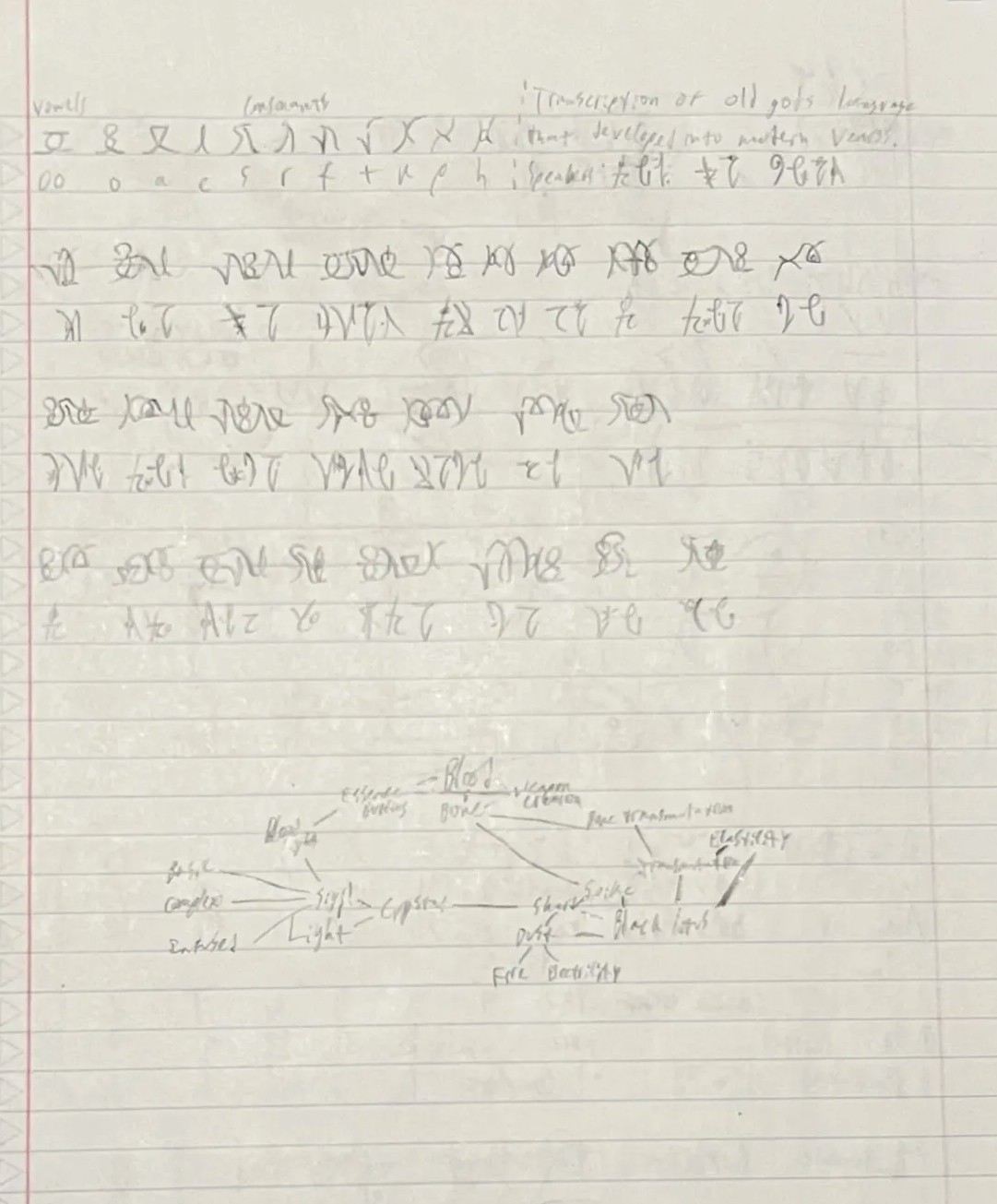
Venris is a constructed language used within the world of Phora Surin by both the gods and humanity. It originated from the first god, Qualme, who needed a way to visualize their thoughts. This originally took the form of Old Venris, which was a simpler form of the modern version that was inscribed on the walls of the divine plane, Anthris. The word Venris is the fusion of the two words - “ven” for "to write", and "ris" as many of these inscriptions sealed parts of Anthris off from the souls. It was later used to communicate with other gods like Phora and Larthe who would then pass it down to humans. Humanity would change Old Venris to fit their needs and different physiology. Other minor languages cropped up throughout the world, but during the unification these languages were lost and modern Venris became the only language spoken in Phora Surin.
It is a language with its own conventions, writing styles, and sounds. There is a lot of freedom in the creation of words which can make it a language that is at times difficult to speak. But it is the first language of humanity in Phora Surin, and not only was the language at the beginning of humanity’s life, and has remained the primary language in the period of cultural stagnation the constant wars have caused. And so remarkably it has largely remained the same over the years.
Languages were in a similar vein to encryption systems. I had tried my hand at creating languages before, but this project was different. This time, my language had a purpose and almost more importantly, a setting. Languages are often shaped by the locations they are found in. The circumstances under which a language develops greatly affect its vocabulary, phonology, grammar, and much more. To bring this project to life, I researched languages online both at home and in my free time at school. Over my junior year in high school, the full language took shape. It is much more than simply a set of words and translations - it's alive with grammar, writing devices, and uses for the script beyond communication and literature. It is not just a language, it is a tool within the world, used to hide and share information or to literally and figuratively control the masses.

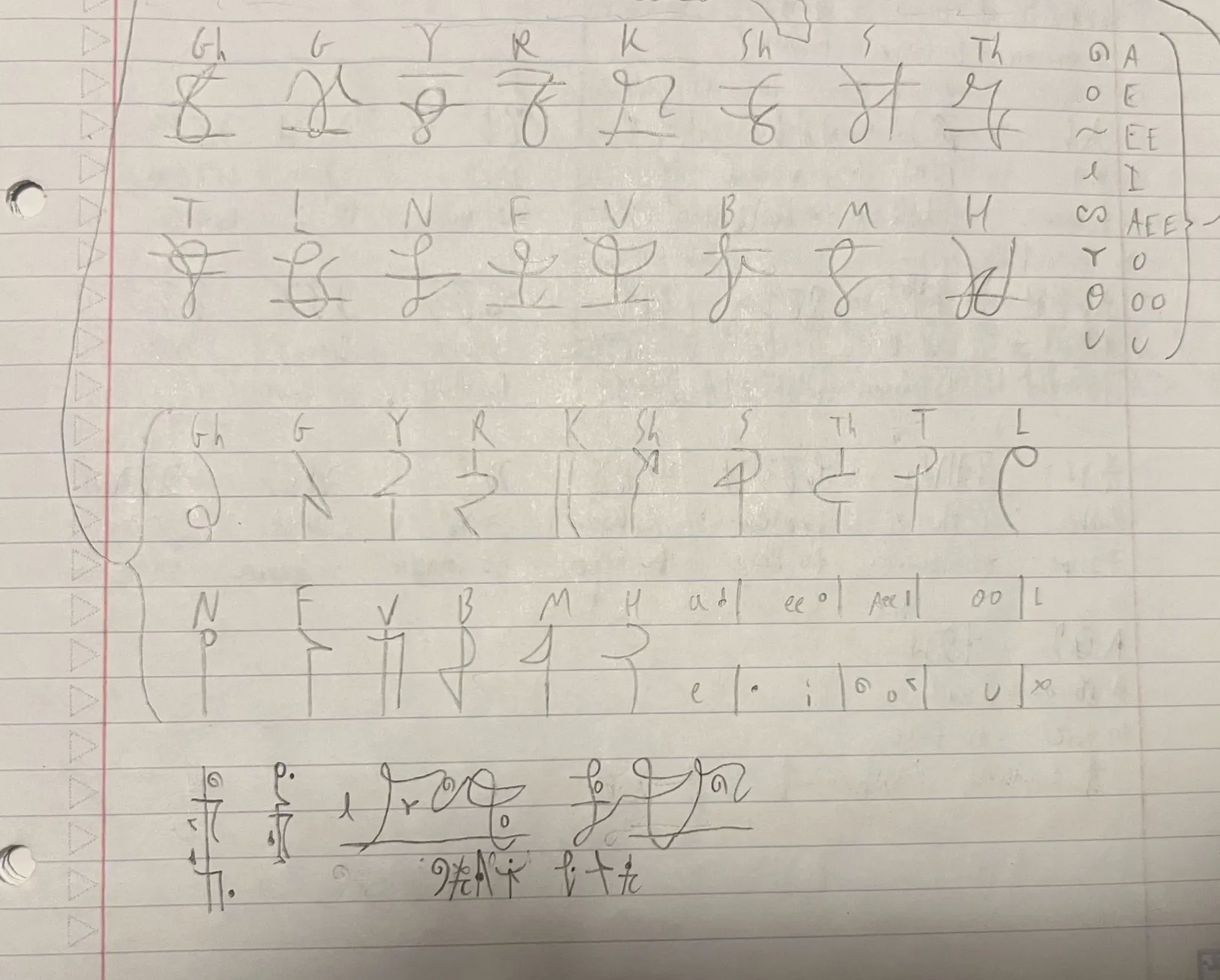
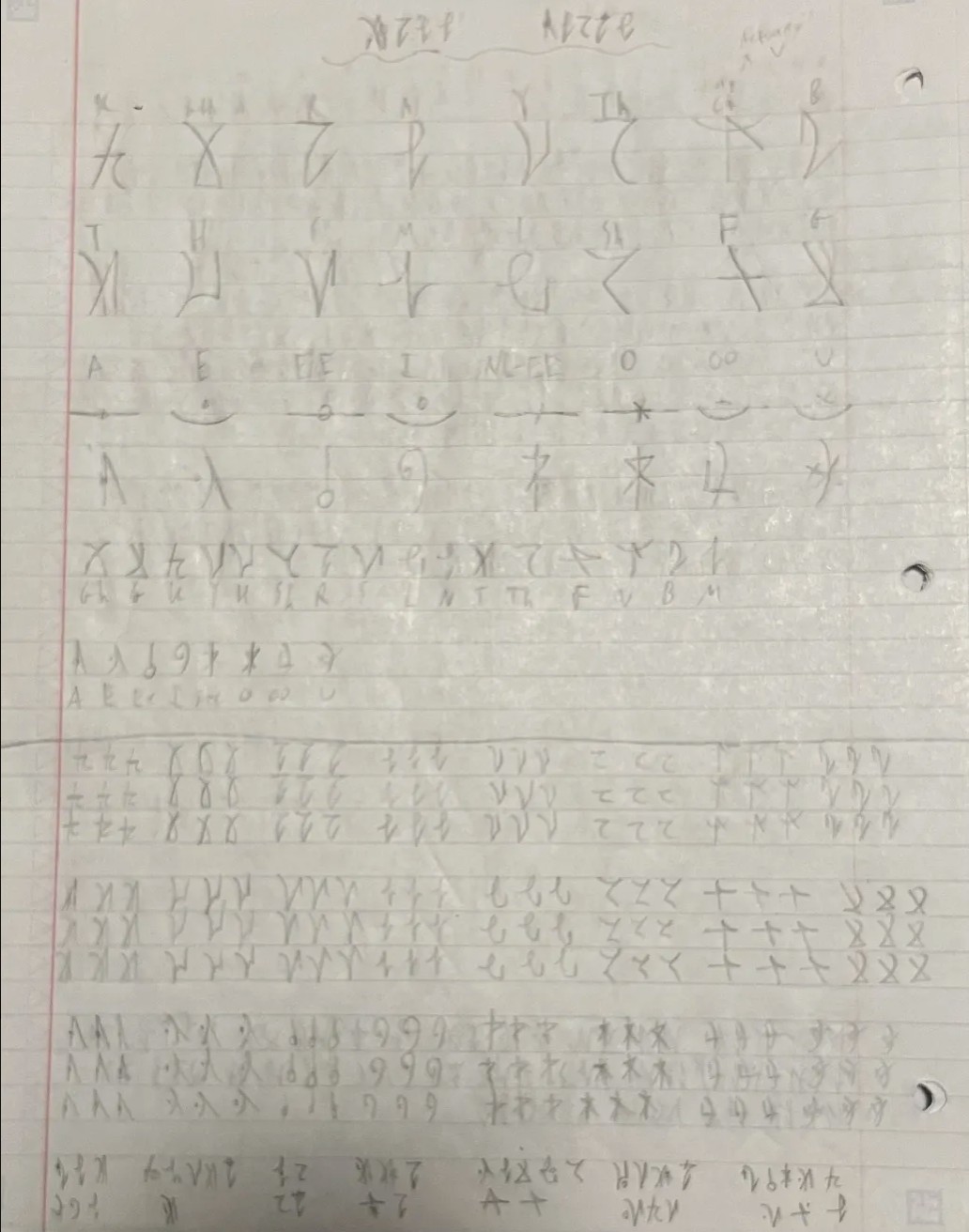
Left: A picture of a notebook page where I originally drafted the characters used in Venris.
Note the changes to the second character from the right. It was originally "ch," then "ng," and landed on "v."
Venris is a simple language that uses an abugida writing system - meaning that it uses a set of base consonant letters and adds vowels as diacritic markings (similar to accents).
There are 24 letters in total with 16 consonants and 8 vowels. If a vowel follows a consonant, it is attached to the consonant as a simplified marking, either directly on the symbol or floating somewhere nearby. These positions are not the same for all letters, and writing conventions shape where the vowel marks should appear. If a vowel is the first letter in a word or follows another vowel, it uses its own specific letter symbol since it has no place to attach to another symbol.
Many of the sounds in Venris are shared with English and Spanish, but some have other origins. These sounds are all mapped to International Phonetic Alphabet symbols, with a table showing the consonant sounds and a graph showing the vowel sounds. These charts were created to concretely define the sounds of Venris rather than relying on the latinized transliterations I had given the symbols at their creation.
Venris words are pretty consonant heavy, and a key feature of its vocabulary is consonant clusters. Oftentimes words have clusters of two or three consonants that conflict in how they should be pronounced. For example, the word for "difficult" is spelled "Kraghg," requiring the growling noise of "gh" combined with the sound of "g" in English. This can sometimes alter the pronunciation of consonants in the word, creating a new sound. In this example (and in my experience), this creates a notable shift in the "g" sound, moving back and deeper into my throat. These consonant clusters are common in Venris, and are mandatory for verb conjugations.
Most sentences begin with verbs, as the language follows a verb-subject-object word order. Practically speaking this enables conversations to get to the point quicker, since the action is conveyed first. Verbs also have unique conjugations which dictate the time at which an action takes place. All verbs in their root form end in one of four consonants specifically reserved for verbs: B, N, Gh, and H. A consonant ending representing the general past, present or future is then added to the root: T, K, and V respectively. After this, other optional endings can be added for more specific time designations. The conjugation of verbs creates consonant clusters which can be large in size depending on the specific verb. For example, "sleep last week" is made up of three parts: "omn" being "to sleep," "T" being the required past tense, and "agl" being the modified for "last week." Together, this creates the word "omntagle", with two consonant clusters, one consisting of three consonants.


Above: Chart of Venris symbols with their latinized transcriptions and their IPA symbols.
Right: IPA chart for vowels.
Below: IPA chart for consonants.

Above: A picture of a notebook page showing the cursive and talisman Venris scripts on the top and bottom respectively.
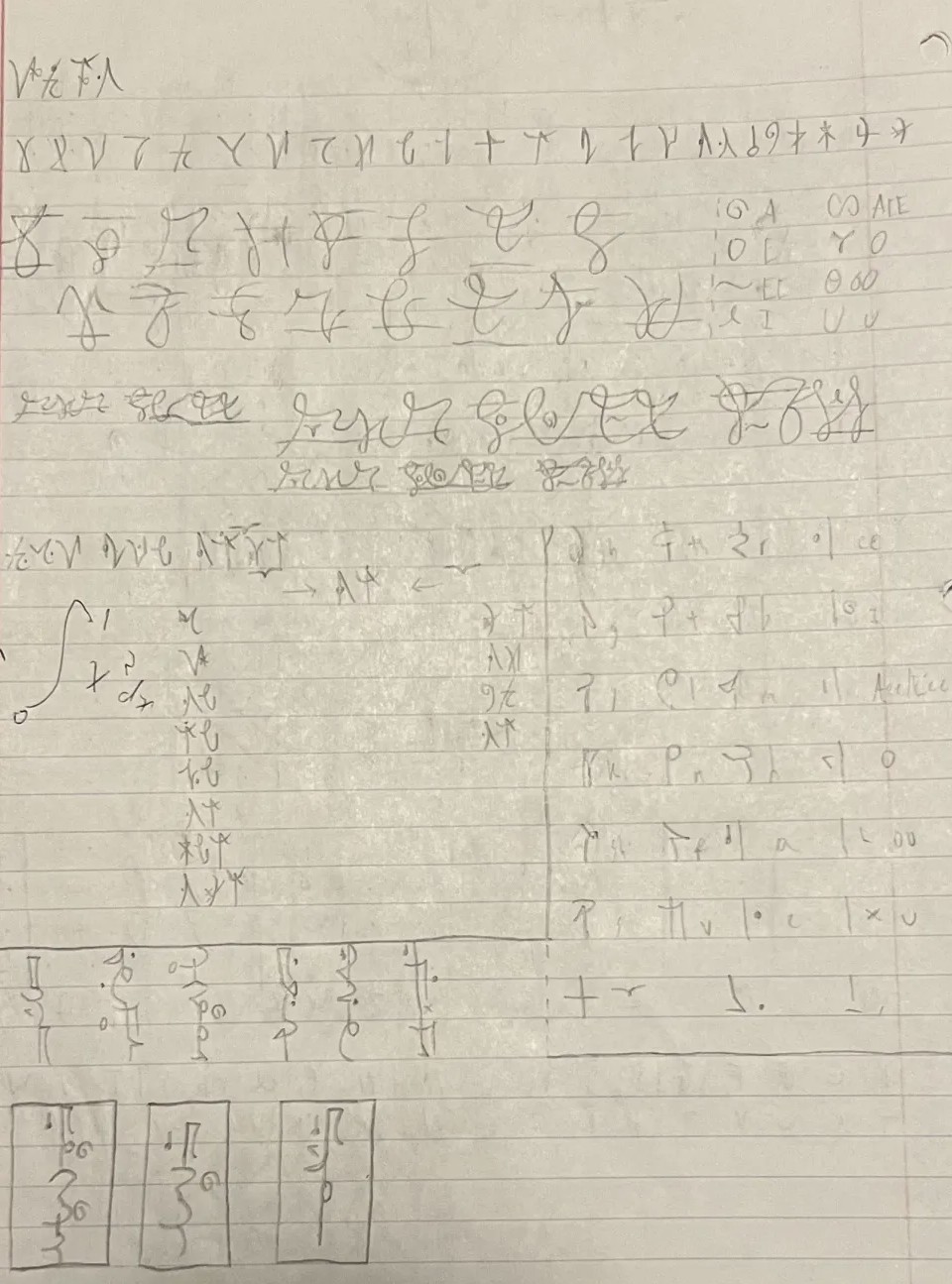
Right: A picture of a notebook page showing the old Venris script and some vocabulary in Venris and old Venris.

Venris doesn't only have one script, however. The script listed above is the
most common and standard version, but there are many others that are used around
the world. There are four other versions of the script in regular use, each with their own purpose and origin. Firstly, there is cursive Venris. As with many cursive scripts, this version of Venris is ornamental and sees very little use outside of decoration. It was not built for speed, but rather for flow and aesthetics. It sweeps and loops across the page, retaining the original vowel diacritic method while gliding across the page. Its loops and curves make space for straight horizontal lines that act as ornaments over the already beautiful symbols. This system was created by the unified kingdom as a more official, elite, and more visually appealing way to make decrees and sign papers. It prioritizes form over function and reflects a time when people cared more about the pleasures in life than the troubles that were brewing.
After the splintering of the unified kingdom, the opposing factions experimented with ways of hiding information, should the kingdom steal letters or send spies. Out of these experiments, Talisman Venris emerged, with a unique writing system that utilized both top to bottom writing for words and left to right for sentences. This system was inspired by the real world Mongolian script which uses a very similar system. The original Venris letters were mimicked in this new script and used across the northwest of the continent to transmit information until it found a new use during the great war. This was the first time the two splintered factions had a large-scale interaction, and it allowed them to combine their magic systems to channel the power of blood. They found that they could imbue words with essence-saturated blood to create small but noticeable effects. And so this script became not only an encryption tool, but also a tool for magic.
From the same time period as Talisman Venris, the other splintered faction in the southeast created an encryption system using circles. This system is a slight alteration to an encryption system I created separately, so information on how this works will be in link.
The final system of Venris is almost entirely a different language, though its fundamentals are still shared with modern Venris. In the same faction as the circle system of Venris, old Venris was being recorded. The leader of the faction interacted with a god frequently enough that they began learning old Venris to record their conversations with the god physically in a way nobody else could read. This system uses vowel clusters and combines various vowels instead of consonant vowel pairs. During the writing process, certain consonants flip the direction of the word and require the writer to write the symbols upside down all the while, connecting letters together in a fluid way. Old Venris was never supposed to be written by mortal hands and yet it was attempted by the leader of the southeast faction.
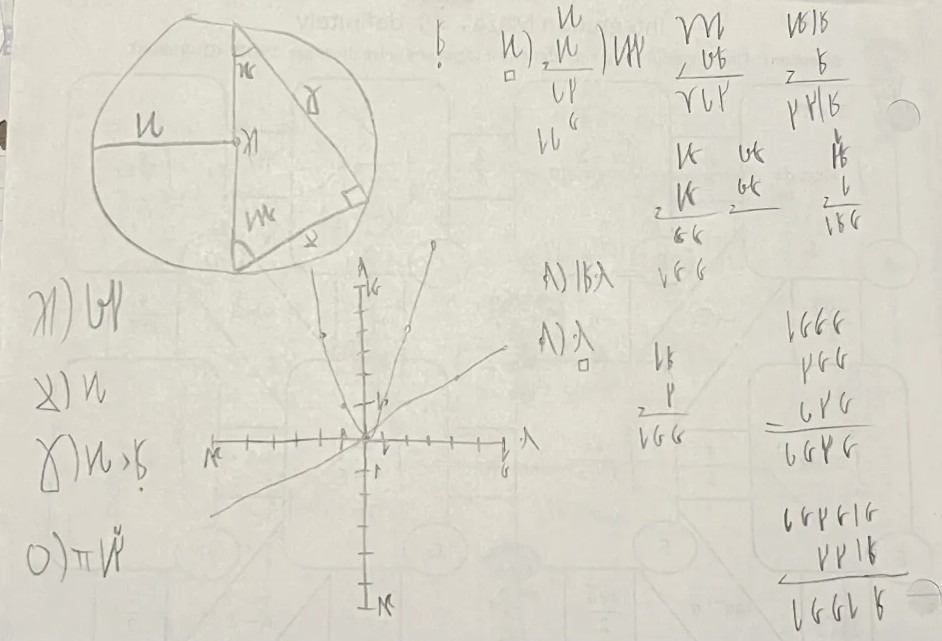
Right: A picture of a notebook page with math done in Venris.
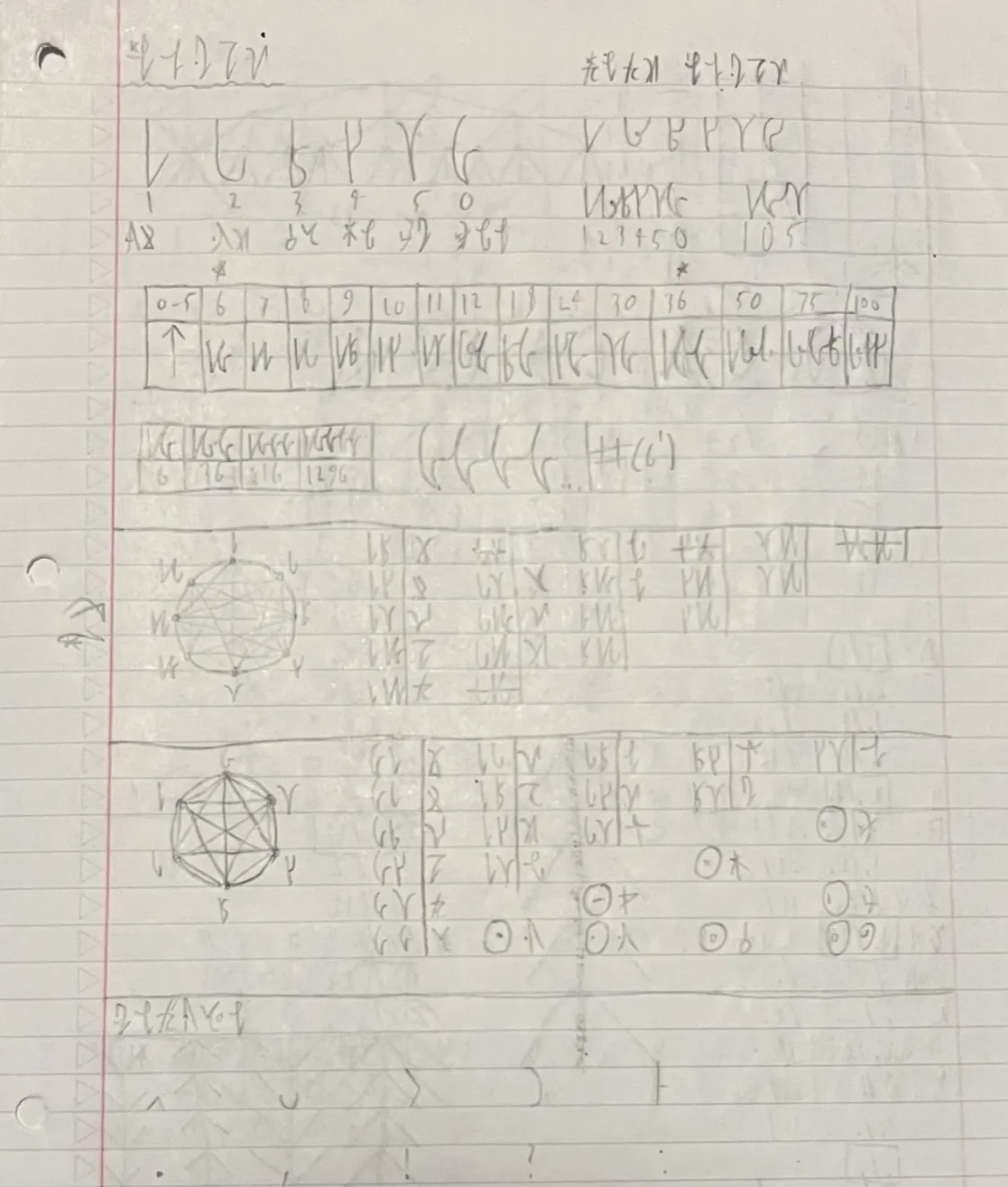
Below: A picture of a notebook page where the numbers of Venris were created originally
Venris also has a unique numbering system. This numbering system was
created after Venris’ original creation by the gods as humans needed a way to
quantify things in a standard, concrete way. The system is founded on base-6, meaning
that instead of counting to nine and increasing in digits to ten, numbers are counted to five before increasing in digits to get to six.
Base ten: 0 1 2 3 4 5 6 7 8 9, then increase by a digit, 10 11 12 ...
Base six: 0 1 2 3 4 5, then increase by a digit, 10 11 12 ...
These numbers have their own symbols and when written out with their own symbols, it begins to make more sense. Each symbol can be displayed by itself, and during mathematical operations this helps to keep equations clear and legible. However, numbers are usually displayed as being connected. Each written numeral extends to the following number, tying them all together into one neat bundle. Prices, numbers on paperwork, answers for mathematical papers. These are all displayed as these “number bundles”. It is only when numbers are alone or being altered that they are separated into individual digits.
Something I found incredibly interesting while working on this was that despite it being a different numbering system, all the math still worked. This actually makes sense logically,since the principles of math are universally consistent. But I was still shocked that even in this fantastical and "weird" way to do math, everything still worked perfectly. It really grew my appreciation for mathematics as a whole, to tinker around with all these mathematical concepts in such a different way than they are usually presented.